Every coffee cup, takeout box, and paper bag has a hidden cost. Here’s why FSCⓇ certification is one key to a better future.
Why FSC® Certified Paper Matters More Than Ever

Authored by Mark Marinozzi
Three Things to Remember:
- Paper isn’t automatically sustainable—where and how its fiber is sourced matters.
- FSC certification supports responsible forestry, habitat protection, and respect for workers and Indigenous communities.
- Look for the FSC label when choosing paper packaging. It provides independent verification of responsible sourcing.
The Forest Stewardship Council (FSC) ensures that paper and fiber-based products are sourced responsibly, meaning forests aren’t clear-cut, habitats aren’t wrecked, and Indigenous communities aren’t pushed aside in the process. FSC certification is the gold standard for responsible forestry⁵.
So, what makes FSC paper different from conventional paper? And does it really make a difference? Let’s dive in.
The Impact of Traditional Paper and Packaging
Most people don’t think twice about grabbing a coffee cup, a paper bag, or a takeout container. But behind each one is a supply chain that’s often devastating for the environment:
- 6.6 million hectares of forest disappear every year. That’s an area the size of Sri Lanka, lost annually⁶.
- Up to 6.5 million trees are cut down just to make the 16 billion coffee cups used worldwide each year⁷.
- 4 billion gallons of water go into paper cup production, enough to meet the daily drinking water needs of 54 million people⁸.
- 231,000 barrels of oil are used annually for the polyethylene linings in conventional coffee cups, making them difficult to recycle⁹.
And it’s not just about trees. Forest destruction has far-reaching consequences, affecting the climate, biodiversity, and communities that depend on healthy forests, and much more. When we clear-cut forests, we not only eliminate critical wildlife habitats but also release stored carbon into the atmosphere, accelerating climate change¹⁰. The stakes couldn’t be higher.
Want more Insights that are better for the planet? |
| Sign up for our Insights newsletter to receive notices in your inbox when we post the best stories on sustainability from our writers and editors. |
FSC Certification: What It Means and Why It Matters
FSC certification is like an insurance policy for forests. When you see the FSC logo on a product, it means:
- The trees are harvested responsibly, with strict limits on how much can be cut¹¹.
- High Conservation Value (HCV) areas, like rainforests and old-growth forests, are protected¹².
- Indigenous communities and local workers are respected and included in the process¹³.
- Wildlife habitats are preserved. FSC forests have 2.7 times more large mammals than non-FSC logging areas¹⁴.
- The paper supply chain is transparent and audited, so there’s greater accountability—not greenwashing¹⁵.
FSC certification isn’t just for wood fiber, either. It applies to bamboo paper, recycled paper, and even alternative fibers. This means we can choose packaging that’s not only tree-free but also made from responsibly grown and harvested materials¹⁶.
FSC Wood vs. FSC Bamboo vs. Conventional Paper
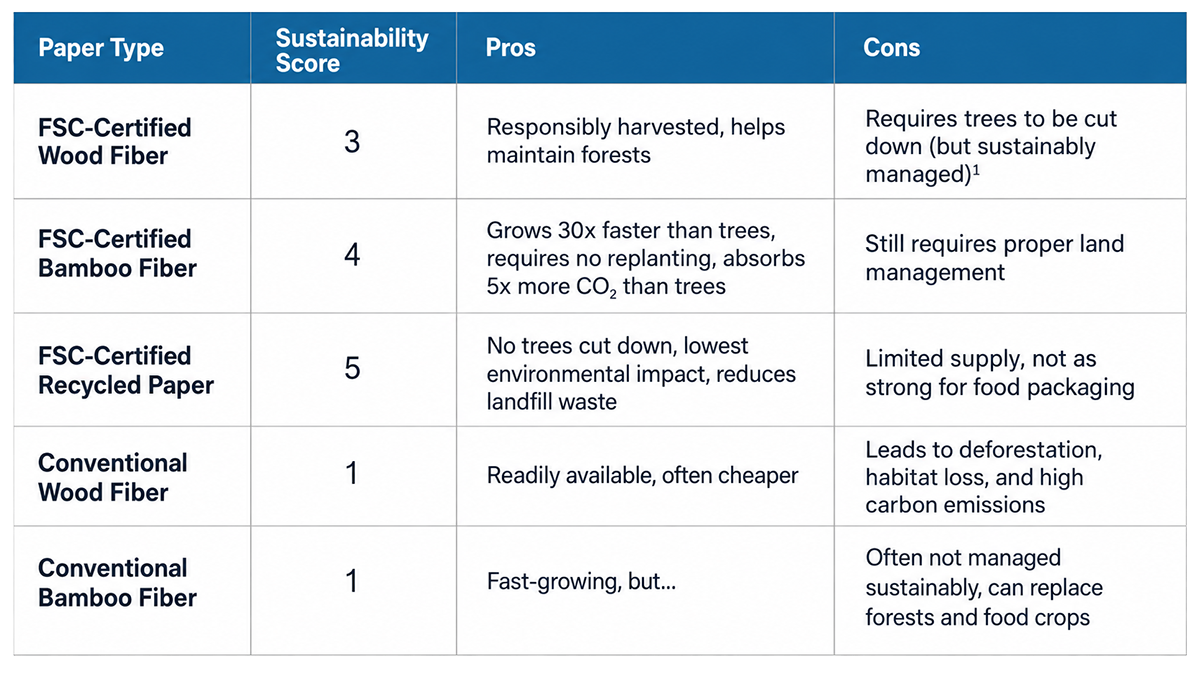
FSC certifies different types of fiber, but which is the most sustainable? Here’s how they compare:
The verdict?
FSC-certified bamboo and recycled paper are the most eco-friendly options, but any FSC-certified fiber is better than non-FSC alternatives. Conventional paper, whether from wood or bamboo, often lacks oversight, which means forests are cut down without accountability. FSC ensures that doesn’t happen.
Why More FSC Certified Products Are Needed Now
Despite the clear benefits, only 13% of the world’s forests are FSC certified²³. That’s nowhere near enough to curb deforestation. However, if businesses, governments, and consumers demanded FSC-certified products, we could flip the script on forest destruction.
Right now, we have a choice:
- Continue using conventional, non-certified paper, contributing to deforestation, climate change, and habitat destruction…
- Or shift towards FSC-certified paper, protecting forests, wildlife, and Indigenous communities while still meeting our needs.
It’s a simple choice, but one that has massive consequences. Choosing FSC is one of the most direct ways to support responsible forestry, cut carbon emissions, and fight biodiversity loss²⁴.
So, the next time you grab a coffee cup, a takeout container, or any paper product, look for the FSC logo. It’s one small action that, multiplied by millions of people, could help turn the tide for forests—and for the planet.
Sources
Global Forest Watch, 2024. 2. FSC Impact Report, 2023. 3. World Wildlife Fund (WWF), 2023. 4. United Nations FAO, 2023. 5. FSC.org, “What FSC Certification Means.” 6. World Resources Institute, 2024. 7. The Guardian, “Disposable Coffee Cups and Deforestation,” 2023. 8. UrbanEthos.co, 2023. 9. Boston Globe, “Plastic Linings in Coffee Cups,” 2023. 10. IPCC Climate Report, 2023. 11. FSC Principles & Criteria, FSC.org. 12. FSC Policy on High Conservation Value Forests. 13. FSC Indigenous Peoples’ Rights Guidelines. 14. Scientific study in FSC-certified forests, Africa, 2022. 15. FSC Chain-of-Custody Standards. 16. FSC Bamboo Certification Guide. 17. REI Expert Advice, “What is FSC Certification?” (rei.com) 18. Journal of Bamboo & Rattan Research, 2023. 19. FSC Recycled Paper Guidelines. 20. IntactForests.org, 2023. 21. NRDC, “The Issue with Tissue” (nrdc.org) 22. Greenpeace Report on Conventional Logging, 2023. 23. FSC Annual Report, 2023. 24. World Economic Forum, 2023.


Join Our Mailing List
Want to stay updated on all things Better Earth? Join our mailing list for updates on latest products, news, innovations, events, sustainability education, and more!
Contact Us
Let us know how our Better Earth team can further help you.
We look forward to hearing from you!
Our Locations
Atlanta
715 Park North Boulevard, #100
Clarkston, GA 30021
(844) 243-6333
Chicago
7447 S. Central Ave., Suite A
Chicago, IL 60638
(844) 243-6333